People-pleasing and hyper-independence look like opposites.
The people-pleaser says, “I’ll do anything to keep you close.” The fiercely self-sufficient person says, “I don’t need you at all.”
One moves toward connection by surrendering the self. The other protects the self by keeping connection at a safe distance.
Yet beneath these opposite-looking strategies lies the same ancient fear: without love and nurturing, I may not survive. Beneath that fear lies an equally ancient shame: as I naturally am, I may not be lovable.
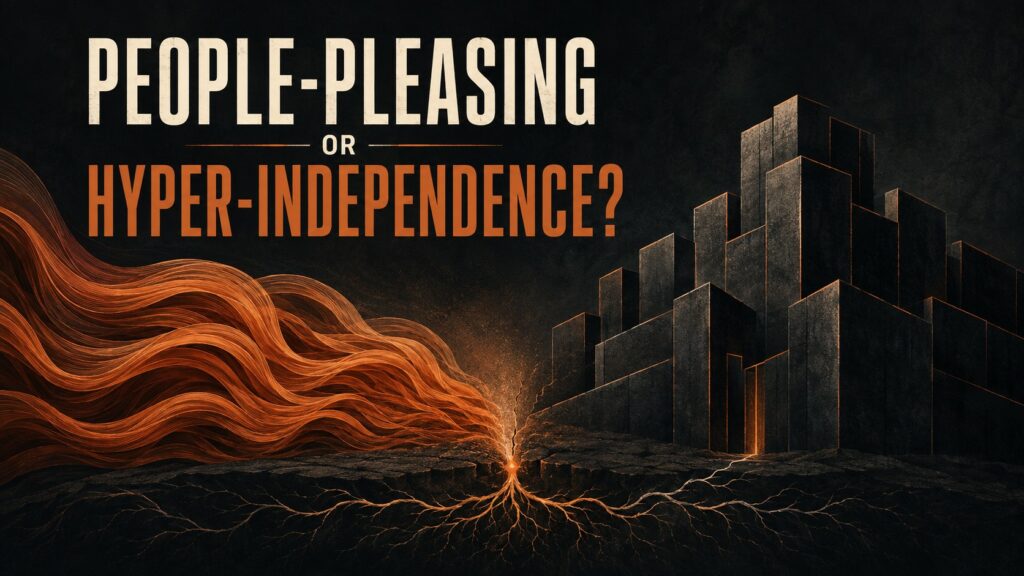
I call these two adaptations collapse and propping.
In collapse, I collapse my centre into you. I organize myself around your feelings, needs and expectations.
In propping, I prop myself into a fortress of self-sufficiency. I make a life out of never needing anyone enough to be hurt by them.
Neither is a character flaw. Both were intelligent responses to conditions that once felt unbearable. The difficulty begins when the strategy becomes an identity—when we forget that it was something we learned to do and mistake it for who we are.
People-Pleasing Is More Than a Bad Habit
Most advice about people-pleasing focuses on behaviour: say no, set a boundary, stop apologizing and ask for what you want.
All of that can be useful. But it does not go deep enough.
People-pleasing is rarely just a collection of bad habits. It is often an entire survival identity.
You may understand perfectly well that you suppress your feelings, monitor other people’s moods and stay silent when you want to speak. You may even know where the pattern came from.
Then the moment arrives to tell the truth, disappoint someone or risk disapproval—and you abandon yourself again.
This is not proof that you have failed. It is evidence that the pattern is operating below the level of insight.
Your nervous system is not responding to the situation as a simple adult disagreement. It is responding as if connection itself—and therefore life—is in danger.
Why Connection Can Feel Like Survival
Human infants are not viable on their own. We depend entirely on other people for food, warmth, touch, protection, soothing and belonging.
Our caregivers do not merely make childhood pleasant or unpleasant. To the young nervous system, they control access to life.
When caregivers are emotionally absent, frightened, controlling, shaming, unpredictable or abusive, a child cannot place their behaviour in context.
An infant does not think, “My mother is overwhelmed,” or “My father is carrying unresolved trauma.”
The child experiences a catastrophic break in the conditions required for survival.
Because blaming the caregiver may feel even more dangerous, the child reaches conclusions about the self:
- My needs are too much.
- My anger is dangerous.
- My spontaneity causes trouble.
- My truth threatens the relationship.
- Who I naturally am is not viable.
These conclusions can remain active decades later.
You may be 40, 60 or 70 years old. You may have your own income, home and successful life. But when someone important becomes angry, distant or disapproving, the old system activates:
Connection is breaking. Your life is in danger. Do something.
Collapse: Losing Yourself to Preserve Connection
Collapse is the classic people-pleasing adaptation.
I study you for cues. I learn your moods, preferences, expectations and disappointments. I anticipate what you need and modify myself to preserve the bond.
I say, “I don’t mind,” although I do.
I say, “It’s fine,” although it isn’t.
Something in me may know what I feel and want, but expressing it seems too risky. Sometimes my own needs go offline altogether because not knowing what I want is safer than knowing and having to reveal it.
The unconscious bargain sounds like this:
I will surrender myself if you promise not to leave me.
This adaptation can easily masquerade as virtue. I may call it kindness, loyalty, compassion, forgiveness or spiritual maturity.
Other people may admire how generous and easygoing I am. But if my generosity requires my disappearance, I am no longer truly in the relationship.
A performance has replaced a person.
Propping: Building a Fortress of Self-Sufficiency
Propping is the opposite-looking adaptation.
Instead of collapsing into you, I build a self that appears not to need anyone. I become controlled, capable, defended and hyper-self-sufficient. I refuse to put myself in a position where another person has emotional leverage over me.
From the outside, this can look like strength. Some of that strength may be real. But underneath it often lies a terror of dependence.
Need itself has become humiliating.
I know this adaptation from the inside.
During ayahuasca ceremonies, the shaman would tell us that if we needed assistance, we should simply call out, “Help.”
I endured intense physical, emotional and spiritual suffering through roughly 50 ceremonies before I could make myself say the word. When I finally did, it emerged as a nearly inaudible whisper.
No one heard me.
That is the fortress at work.
The unconscious bargain is:
I will surrender connection if doing so guarantees that I can never be abandoned.
Authentic individuality is different. It means I can stand on my own feet and remain in relationship.
Propping is defensive individuality. It may be organized into the body itself: the rigid back, tight muscles, controlled voice and relentless refusal to soften.
The propped person says:
I will not need you, so you cannot leave me.
Why Both Strategies Are Exhausting
Collapse and propping demand tremendous energy because both require constant vigilance.
The collapsed person monitors the stability of connection:
- Are you upset with me?
- Did I say the wrong thing?
- Are you pulling away?
- Should I apologize or explain myself more clearly?
- What can I do to make this better?
The propped person monitors the threat of connection:
- Am I beginning to need you?
- Are you getting too close?
- Do you expect something from me?
- Am I losing control?
- How can I create enough distance to remain invulnerable?
The collapsed person exhausts themselves maintaining connection.
The propped person exhausts themselves defending against it.
How Our Gifts Become Organized Around Survival
The life force within us does not disappear when it encounters these blocks. It grows around them, much like a tree growing sideways around an obstacle.
Our natural capacities survive, but they become distorted by the conditions through which they must pass:
- Sensitivity becomes hypervigilance and hyper-empathy.
- Care becomes compulsive caretaking.
- Adaptability becomes self-disappearance.
- Strength becomes invulnerability.
- Autonomy becomes isolation.
We may appear highly functional. We may even be rewarded for these qualities.
But our gifts have been organized around survival rather than full self-expression.
Why People-Pleasers Eventually Withdraw
Most of us are not exclusively collapsed or propped. We move between the two.
This toggling explains a pattern that confuses many couples: the apparently warm, available and accommodating person eventually withdraws.
When accommodation becomes unbearable, the collapsed person may stop answering, become passive-aggressive or turn emotionally unavailable.
They continue to perform the duties of the relationship, but withhold their needs, affection, sexuality, creativity and presence. They are technically there, but no longer truly available.
This is a passive and often unconscious form of hyper-independence.
The person may not announce, “I don’t need anyone.” Instead, years of self-suppression eventually produce an internal retreat.
The predominantly propped person can move in the opposite direction. Their dependence remains concealed until the relationship is threatened.
Then the fortress can collapse very quickly. They may become desperate for reassurance, defensive about their lack of connection or terrified of being left.
This is why people-pleasing and hyper-independence belong in the same conversation.
One person sacrifices the self to protect connection. The other sacrifices connection to protect the self.
Many of us do both.
The Shame Beneath People-Pleasing and Hyper-Independence
Beneath both adaptations lies shame.
Shame is more than embarrassment. It is the felt loss of legitimacy—the sense that I do not have the right to exist as I am, with my own needs, emotions, intensity, desires and truth.
The collapsed person tries to solve shame by becoming acceptable:
If you cannot love me as I am, perhaps you will love this carefully managed version of me.
Life becomes a performance.
The propped person tries to solve shame by making love unnecessary:
If I want nothing from you, it will not matter whether you find me lovable.
But this protection eventually produces loneliness, meaninglessness and alienation.
In both cases, the person avoids risking the revelation of the true self. One hides through compliance. The other hides through invulnerability.
What Genuine Intimacy Requires
Neither collapse nor propping makes genuine intimacy possible.
Intimacy requires two actual individuals. I must be able to remain myself while allowing you to remain yourself. We then bridge the difference with love.
For me, one of the clearest descriptions of love is:
I will let you be without leaving you alone.
That is the mature alternative to both strategies.
I do not abandon myself to keep you close. I do not abandon you to protect myself. I remain present as a distinct person who can need, choose, speak, disagree, receive and love.
This does not mean perfect independence or effortless boundaries.
It means increasing our capacity to notice when an old survival identity takes over—and returning, degree by degree, to our own centre.
Do You Collapse, Prop—or Move Between the Two?
Consider what happens when love, approval or belonging feels uncertain:
- Do you accommodate, explain, apologize or lose track of what you need?
- Do you withdraw, withhold or convince yourself that you need nobody?
- Do you accommodate until resentment becomes unbearable, then disappear emotionally?
- Do you present as fiercely independent, then collapse when the relationship is threatened?
There is no failure in recognizing yourself here.
Both adaptations were attempts to preserve life under difficult conditions. The work is not to shame the strategy. It is to see that the conditions have changed—and that you now have choices you did not have before.
You can stand on your own feet without building a fortress.
You can love another person without disappearing into them.
You can include yourself in the equation.
That is where the movement beyond people-pleasing begins: not with becoming less loving, but with finally allowing the person who loves to be present too.
Ready to Stop Abandoning Yourself for Love?
Join the free End People Pleasing community for weekly teachings, practical exercises and conversations about learning to stand up, speak up and show up without sacrificing connection.
[INSERT LINK TO END PEOPLE PLEASING COMMUNITY]
Bruce Sanguin, RMFT, is a registered marriage and family therapist, author and creator of the Heart Self Method. He helps people stop abandoning themselves for love and begin living their own unrepeatable lives.