Can we love a life that will keep breaking our hearts?
I read Ernest Becker’s The Denial of Death in my early twenties. It had a profound impact on me. Then, as happens with books that once seemed to explain everything, I largely forgot about it.
A recent article brought it back. In particular, this phrase: “an immunity bath.”
G. Stanley Hall, the first president of the American Psychological Association, used the phrase in 1915 to describe the function of ancient mystery cults. The devotee entered the temple, submitted to the rites, and received symbolic protection against what Hall called “the greatest evil: death and the dread of it.”
Becker took up Hall’s image in The Denial of Death. The temple, he argued, was one expression of a much larger human undertaking. Cultures provide systems of meaning through which our small, vulnerable lives participate in something that appears enduring. Religion, nation, revolution, civilization: we lend ourselves to a story that promises to outlast us.
We become significant participants in something greater. Our mortality becomes more bearable.
Reading this again, I found myself wondering whether death is the whole story.
Perhaps what we seek is immunity from suffering, with death its most absolute expression.
We want protection from heartbreak. Humiliation. Abandonment. Helplessness. The discovery that being good does not protect us, that love guarantees nothing, that life will never become entirely safe.
We want somebody to know what to do about this.
And there is always somebody willing to tell us.
The temple changes
The shaman, the chief, the priest, the guru. Today, too, the physician, psychiatrist, epidemiologist, politician, economist, financial adviser, therapist.
Their knowledge differs, as does the help they can offer. But any of these figures can become the bearer of a promise that exceeds their actual capacities:
Follow this system. Accept this explanation. Perform this practice. Place yourself in our hands.
We will make you safe.
The promise need never be spoken so plainly. We bring our longing to the encounter. We invest the authority with powers they may welcome, exploit, or conscientiously refuse.
There is a bargain available here. The authority receives our allegiance. We receive relief from uncertainty.
A profession becomes a priesthood when its authority becomes sacred: when questioning it is treated as a moral failure, when uncertainty must be concealed, when belonging depends upon assent.
Under these conditions, a practice can acquire a significance beyond its practical purpose. It becomes an initiation, a visible declaration of membership in the community of the responsible, the virtuous, the enlightened.
Refusal then becomes more than disagreement. It threatens the reassurance that holds the community together.
This is a temptation in alternative and spiritual communities as well. A guru can demand submission as readily as an institution. Rejecting official expertise does not free us from the longing for an infallible authority.
We can leave one temple and immediately build another.
Three things I was told
During an ayahuasca ceremony, I received a teaching that was remarkably free of reassurance:
Life is suffering.
It isn’t fair.
There is no escape.
I did not hear that life contains nothing but suffering. There is beauty, pleasure, friendship, laughter, the astonishing fact that anything exists at all.
But suffering belongs to existence. It cannot finally be engineered out of it.
Nor is suffering distributed according to merit. Children suffer. Cruel people prosper. People who have already endured more than enough receive another devastating loss.
And there is no final arrangement of beliefs, possessions, practices, or relationships that will exempt us.
Hearing this, I could feel how much of my life had been organized around negotiating an exception.
Surely, if I understood enough. Healed enough. Became sufficiently conscious. Found the right practice. Acquired enough money. Finally became the person I was supposed to be.
Surely then.
The teaching closed that door.
Everything can be put to use
Almost anything can be recruited into the project of avoiding reality.
We accumulate wealth until security becomes an endlessly receding number. We consume until we no longer notice what we hunger for. We use substances to interrupt contact with ourselves. We adopt beliefs that promise certainty about what existence means and how the story ends.
We can also meditate.
We can become accomplished at observing feelings we have never allowed to break our hearts.
We can attend ceremony after ceremony, seeking another opening while postponing the difficult conversation waiting at home.
I include therapy here, and therefore my own profession. Therapy can help us recover capacities we needed to suppress in order to survive. It can also become an indefinite preparation for living, with another wound always needing attention before we dare to inhabit our life.
The question becomes: What am I asking this practice to do for me?
Am I becoming more available to existence?
Or am I trying to establish conditions under which existence will no longer be able to hurt me?
The immunity bath can be offered in a temple, a consulting room, a shopping mall, a retreat centre. We can even administer it to ourselves through the private conviction that we have finally figured everything out.
Ceremony without a bargain
This is where I have begun to understand ceremony differently.
I understand the desire to come to ceremony for healing, belonging, relief, or guidance. I have come with those longings myself.
But ceremony deepens when I stop making its value dependent upon what it gives me.
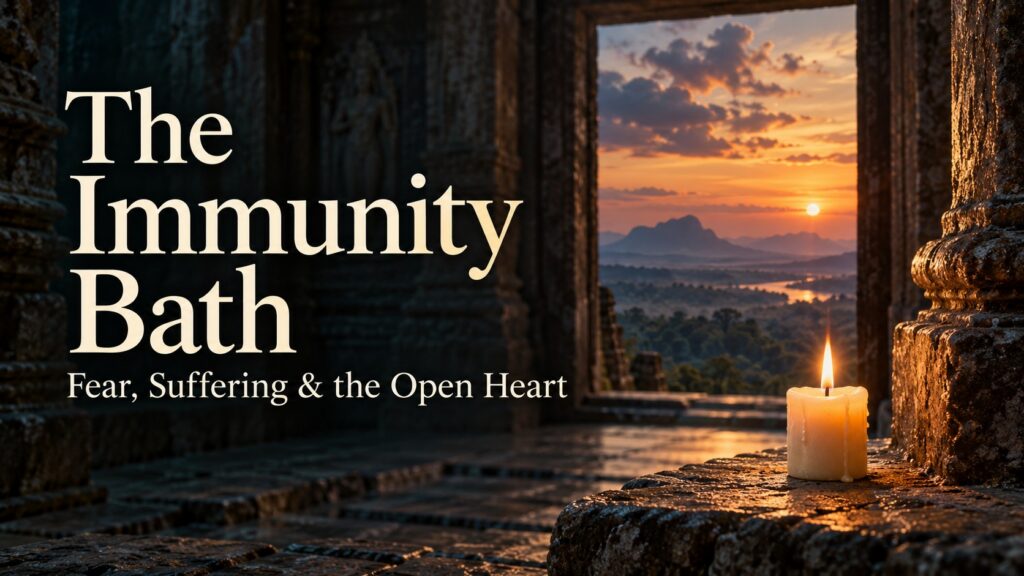
A candle is lit. A prayer is spoken. An offering is made. I remember the dead. I give thanks for food. I sit beside a fire without requiring it to deliver an insight.
The act is complete in the doing.
I am making direct, honest contact with the mystery of being here.
There may be comfort. There may be grief. There may be an unsettling silence in which none of my explanations seem adequate.
The ceremony owes me no particular experience. It provides no guarantee that my suffering will diminish or that my life will work out.
I enter without a contract.
This is where my understanding of ceremony parts company with the immunity bath. The ritual Hall described offered symbolic protection against mortality. The ceremony I am trying to describe brings me into intimate contact with a life whose vulnerability cannot be removed.
Even gratitude can become instrumental: If I practise gratitude, perhaps I will be happier.
But there is another possibility. I give thanks because I have received something. The thanks need accomplish nothing further.
I grieve because I have loved.
I pray because I am here, in a mystery I cannot explain.
The suffering that is ours to suffer
There is suffering we can and should relieve. We can treat pain, leave an abusive relationship, oppose cruelty, seek help, feed somebody who is hungry.
Medicine can help. Therapy can help. Wise guidance can help. None needs to offer immunity from the human condition to be valuable.
“No escape” does not mean every painful circumstance must be endured. It means that even a life well cared for remains vulnerable.
There is grief that belongs to having loved. Disappointment that belongs to having hoped. Sorrow that belongs to recognizing the harm we have caused.
I think of neurotic suffering as the additional suffering generated by my refusal to undergo what is already here.
A relationship has ended, but I keep conducting the argument that will make its ending impossible. Someone cannot give me the love I want, but I organize my life around finally extracting it. I have made a mistake, but I punish myself rather than bear the sorrow of having caused harm.
These refusals often began as necessary protections. We learned to defend ourselves when there was nobody to help us bear what happened.
Eventually, though, the defence can become more imprisoning than the pain it keeps at bay.
Something changes when I can say: This has happened. It hurts. I cannot make it unhappen.
Then grief has somewhere to go.
Will you still love life?
Is there a point to suffering?
I hesitate to answer too quickly. I do not want to explain somebody else’s devastation as a lesson they needed. Some suffering destroys possibilities that should have been protected. Compassion requires us to acknowledge that.
But I can ask what becomes possible within my own suffering.
When my heart breaks, will I still love life?
Will I love it knowing that my willingness to love leaves me open to being brokenhearted again?
Suffering does not automatically make us compassionate. It can make us bitter, frightened, preoccupied with securing power. We may decide that we will never again allow ourselves to be so exposed.
Then control begins to look like salvation.
We manage other people so they cannot disappoint us. Manage ourselves so no unruly desire disturbs the arrangement. Demand certainty from authorities, loyalty from loved ones, obedience from life.
Religion can serve this project. So can wealth, political power, spiritual discipline, or the insistence that everyone else must see the world as we do.
Beneath the demand for control, I often find a frightened heart trying to prevent another unbearable experience.
I recognize that heart. It is my own.
Keeping it open is a practice of returning, sometimes after a long absence. I close. I defend. I reach for certainty. Then perhaps I notice what I am doing, and feel the sorrow beneath it.
I begin to recognize that the person before me is also living a life they cannot secure against loss.
Compassion becomes possible there.
I can hear grief without rushing to explain it away. I can establish a boundary without needing to humiliate the person on the other side. I can act against cruelty while remembering how readily fear turns into domination.
I cannot tell you that existence will reward us for keeping our hearts open. That would be another promise of protection.
I can only say that I want to be here for this life while I have it. To love the people I love without making their permanence a condition. To grieve what passes. To allow beauty to reach me, even knowing I cannot keep it.
This is the ceremony I want to live.
The candle burns down.
I am grateful to have lit it.