Recovering the Image of God Within Us
The word sin has suffered a tragic fate.
For many people it conjures images of guilt, shame, moral failure, or an angry God keeping score of human behaviour. It has become one of the least useful words in the spiritual vocabulary because it has been reduced to a catalogue of offences.
I don’t mean sin that way.
I mean something much older.
The ancient idea of sin was not primarily about breaking rules. It was about missing the mark. It described a condition in which human beings had become separated from their deepest reality. Alienated from God. Alienated from one another. Alienated from the earth. Alienated from themselves.
Sin, in this sense, is not first a moral problem.
It is an existential one.
It is the experience of living at a distance from the life we were created to embody.
And perhaps nowhere is this alienation more visible than in what I call the sin of self-omission.
We Are Born Into a World Already Divided
One of the most difficult ideas for modern people to accept is that none of us begins life with a blank slate.
We inherit a world.
We inherit families shaped by generations before us. We inherit nervous systems marked by fear and adaptation. We inherit religions that have sometimes nurtured life and sometimes denied it. We inherit economies that teach us our worth depends upon productivity. We inherit cultures that reward performance more readily than authenticity.
Long before we can choose our lives, life has already begun shaping us.
This is why I have come to rethink the old doctrine of original sin.
I do not believe babies arrive guilty.
That has never made sense to me.
Babies do not sin.
They simply arrive in a world that has forgotten itself.
They are born into cultures of alienation.
The alienation is already here.
A child doesn’t invent shame.
A child doesn’t invent violence.
A child doesn’t invent racism, domination, perfectionism, or people pleasing.
Children inherit these realities and then do what children have always done.
They adapt.
The Brilliant Adaptation That Becomes a Prison
Suppose you discover, without anyone ever saying it directly, that your parents become anxious whenever you express anger.
What do you do?
You become agreeable.
Suppose your sadness is ignored.
You stop feeling it.
Suppose love seems to arrive only when you’re helpful.
You become indispensable.
Suppose conflict threatens belonging.
You become a peacemaker.
These are not moral failures.
They are acts of genius.
The child isn’t choosing self-abandonment.
The child is choosing life.
The nervous system asks only one question:
How do I stay connected to the people I need in order to survive?
And so little by little we begin omitting ourselves.
Not because we are weak.
Because we are brilliant.
The tragedy is that what begins as adaptation slowly hardens into identity.
Forty years later we no longer remember adapting.
We simply say,
“This is who I am.”
The Deepest Alienation
People often imagine alienation as something dramatic.
They picture loneliness.
Isolation.
Depression.
Sometimes it looks like that.
But often alienation wears a much friendlier face.
It looks like being endlessly accommodating.
It looks like smiling when your heart is breaking.
It looks like saying yes while every fibre of your being wants to say no.
It looks like becoming extraordinarily skilled at understanding everyone else’s inner world while remaining almost completely disconnected from your own.
The deepest alienation is not that we lose contact with other people.
It is that we lose contact with ourselves.
We become strangers in our own lives.
We know what everyone else thinks.
We know what everyone else needs.
We know what everyone else expects.
But ask a simple question—
“What do you want?”
—and many people fall silent.
Not because they don’t care.
Because somewhere along the way they stopped asking.
This is self-omission.
Why It Matters Spiritually
Some people hear all of this and think it is simply psychology.
I don’t.
I think it is profoundly spiritual.
The Judeo-Christian tradition says that every human being is created in the image of God—the imago Dei.
Traditionally we’ve treated this as something we possess.
Almost like a theological possession tucked away somewhere inside us.
I have begun to think of it differently.
The image of God is not merely something we have.
It is something longing to become visible.
Creation itself seems to be engaged in a long, patient process of bringing forth uniqueness.
No two snowflakes.
No two fingerprints.
No two human beings.
Reality appears to delight in originality.
Which means your deepest calling is not becoming someone else.
It is allowing the unique expression of Life that has taken the shape of you to become visible.
When we hide ourselves…
When we endlessly perform…
When we disappear into the expectations of others…
Something sacred remains concealed.
The tragedy is not that God becomes angry.
The tragedy is that the image of God cannot fully shine through us.
Perhaps the deepest form of sin is not breaking commandments.
Perhaps it is denying Reality the opportunity to express itself uniquely through our lives.
Responsibility Begins Here
None of us chooses the conditions into which we are born.
None of us chooses our family.
None of us chooses the fears that shaped our nervous system.
None of us deserves blame for becoming alienated.
But there comes a moment when innocence is no longer enough.
Eventually life asks something of us.
Not guilt.
Not shame.
Responsibility.
The word itself is beautiful.
The ability to respond.
Not simply to repeat.
Not simply to react.
To respond consciously.
We did not create the prison.
But eventually the key is placed in our hands.
Healing begins the moment we accept that responsibility.
Not because we caused the wound.
But because we are now the only ones who can participate in its healing.
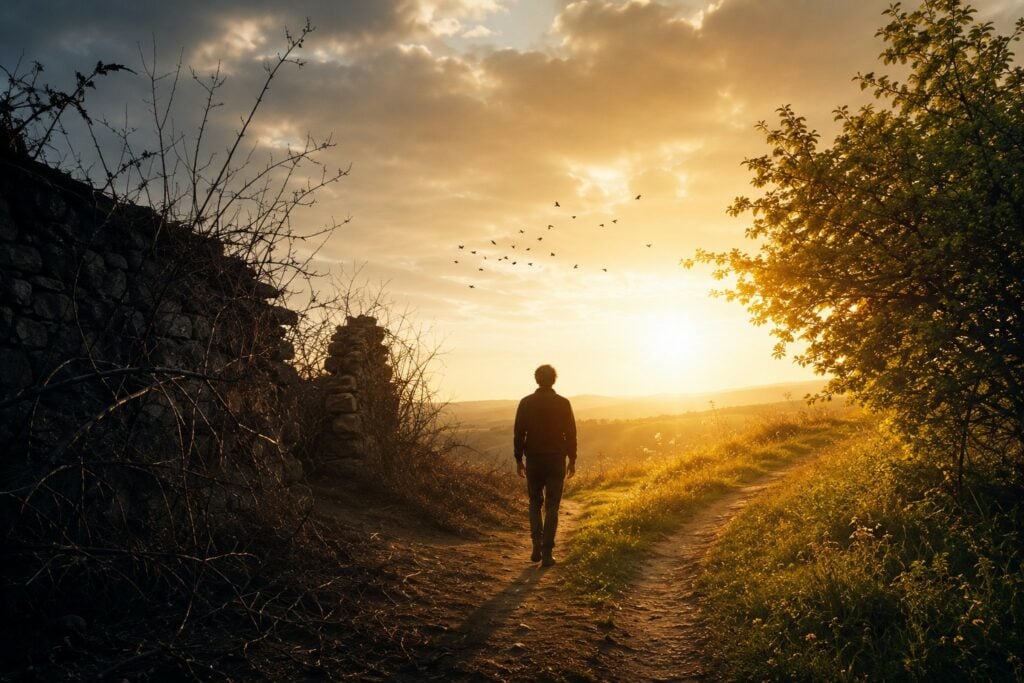
The Journey Home
The spiritual journey is often imagined as climbing higher.
I suspect it is more like coming home.
Coming home to the body.
Coming home to our own experience.
Coming home to the earth.
Coming home to relationships that allow truth instead of performance.
Coming home to God—not as an external judge, but as the very Source of Life continuously inviting us into fuller participation.
This is why compassion matters so much.
You cannot shame yourself back into your own life.
You cannot criticize yourself into authenticity.
The adaptations that now imprison you once protected you.
Honour them.
Thank them.
And then gently let them know they are no longer running the show.
Showing Up
Every day offers countless opportunities either to omit ourselves or to reveal ourselves.
To tell the truth when it would be easier to perform.
To say no without guilt.
To receive love without earning it.
To create something no one asked us to create.
To speak with our own voice instead of borrowing someone else’s.
These moments may seem small.
They are not.
Each one is an act of incarnation.
Each one allows something of the image of God to become visible in the world.
Every authentic conversation.
Every courageous boundary.
Every honest tear.
Every work of beauty.
Every act of forgiveness.
Every expression of love freely given.
These are not merely psychological achievements.
They are revelations.
The universe becomes more fully itself every time a human being becomes more fully themselves.
The Sin That Can Be Redeemed
Perhaps the good news is this:
The sin of self-omission is not permanent.
Alienation is not our destiny.
The journey of healing is not the construction of a better personality.
It is the recovery of our participation in Life itself.
We discover that beneath all the adaptations there has always been something intact.
Something quietly waiting.
Something that never stopped believing in our possibility.
Call it the Heart Self.
Call it the soul.
Call it the image of God.
The name matters less than the experience.
Its invitation is always the same.
Come home.
Come home to your own experience.
Come home to your own voice.
Come home to your own life.
Because the world does not need another perfectly adapted human being.
It needs the one person who has never existed before.
It needs the particular way that Life longs to express itself through you.
That, perhaps, is our deepest responsibility.
To stop omitting ourselves.
To become transparent to the Life that has always been trying to live through us.
And in doing so, to discover that salvation is not escape from the world.
It is participation in it.
Fully.
Courageously.
Lovingly.
As ourselves.