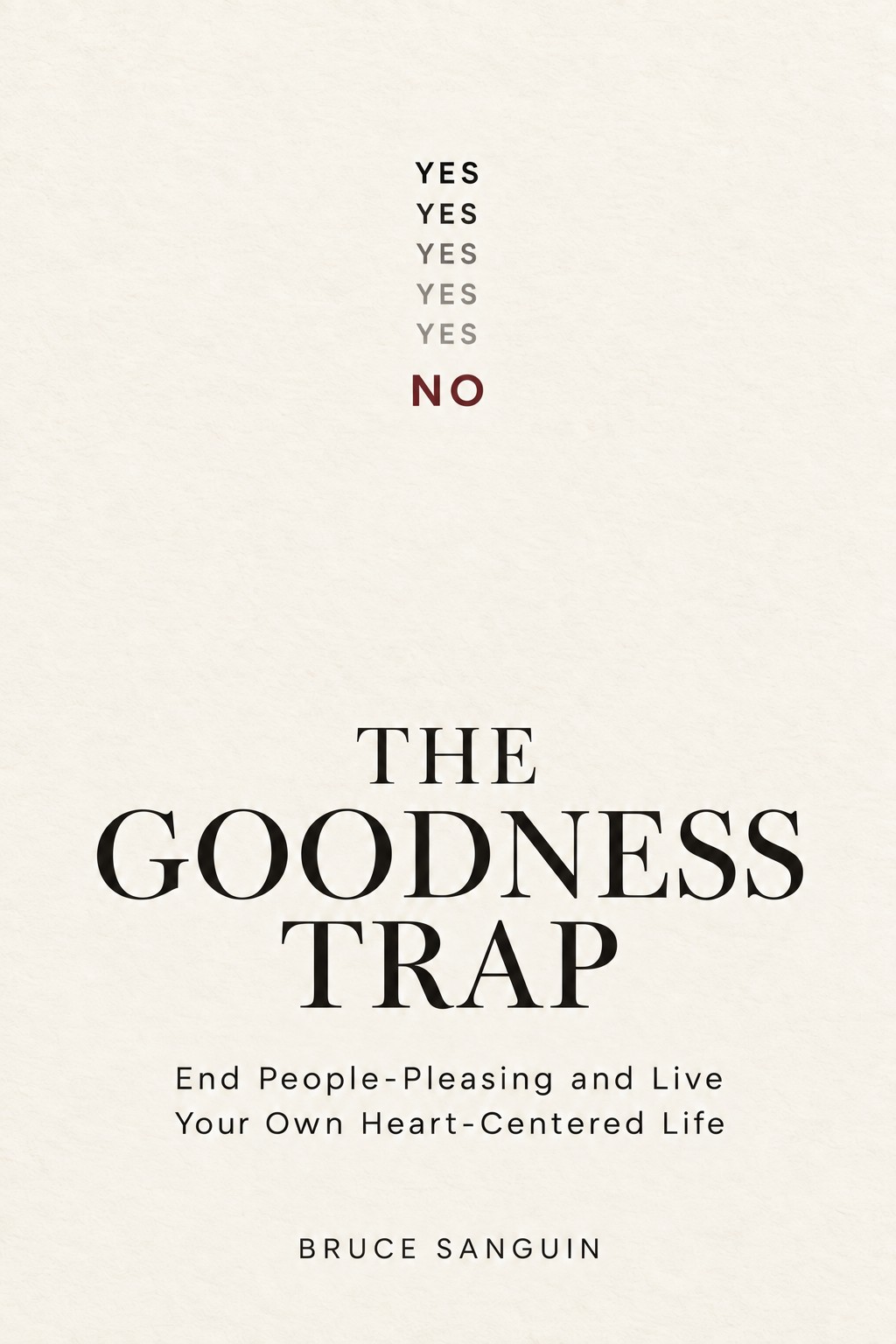
People-pleasing looks nice from the outside.
You are agreeable. Accommodating. Helpful. You anticipate what other people need. You avoid unnecessary conflict. You learn to read the room and adjust yourself accordingly.
But there is a dark side of people-pleasing that we don’t talk about nearly enough.
Underneath all that niceness there may be feelings that don’t seem nice at all: anger, resentment, hatred, even rage.
And underneath those feelings, very often, is shame.
Not ordinary embarrassment. Something much more primal: There is something wrong with me. I shouldn’t feel this way. I shouldn’t want what I want. Maybe I shouldn’t even be here.
This is where people-pleasing meets what psychologists have sometimes called the shadow: the feelings, impulses, desires, and aspects of ourselves that we learned were unacceptable and therefore had to be pushed out of awareness.
The problem is that they don’t actually disappear.
They go underground.
People-Pleasing Begins as Adaptation
People-pleasing is often described as though it were simply a bad habit.
You care too much what other people think. You need better boundaries. You need to learn how to say no.
There’s truth in that, but it doesn’t go nearly deep enough.
For many people, people-pleasing began as an intelligent adaptation to their environment.
Imagine a child growing up with a parent who is volatile, controlling, shaming, emotionally unavailable, or simply unable to tolerate the child’s full emotional reality.
What does the child do?
The child adapts.
Perhaps you discover that Dad likes you better when you’re agreeable. Mom becomes anxious when you’re angry. Your family rewards achievement but doesn’t know what to do with vulnerability. Maybe expressing a preference leads to ridicule, withdrawal, punishment, or humiliation.
So you start editing yourself.
You become easier.
You become good.
You learn to anticipate other people’s emotional states and organize yourself around them.
But this raises an important question:
What happens to all the feelings that don’t fit the adaptation?
They have to go somewhere.
The Shame Beneath People-Pleasing
One of the deepest feelings beneath chronic people-pleasing is shame.
Shame is different from guilt.
Guilt says, I did something wrong.
Shame says, There is something wrong with me.
And childhood shame can go deeper still:
I shouldn’t even be here.
For a young child, relationships with caregivers are not optional. They are the child’s world. So when something repeatedly goes wrong in those relationships, the child is unlikely to conclude, “My father is emotionally immature,” or “My mother is projecting unresolved trauma onto me.”
Children don’t have that conceptual framework.
Instead, they tend to locate the problem in themselves.
It must be me.
And from that conclusion an entire personality can begin to organize itself.
I need to be better.
I need to be quieter.
I need to stop upsetting people.
I need to accomplish more.
I need to make myself useful.
I need to figure out what everybody wants from me and become that.
This is the soil in which people-pleasing grows.
But shame is only part of the story.
Because there is another perfectly natural response to being controlled, humiliated, ignored, frightened, or mistreated.
Anger.
The Hidden Rage Beneath People-Pleasing
This is where things get uncomfortable.
We don’t like admitting that children can hate their parents.
We don’t like admitting that a frightened child can experience enormous rage toward the person frightening them.
But why wouldn’t they?
If somebody repeatedly humiliates you, controls you, dismisses you, or makes you feel unsafe, anger is not evidence that something has gone wrong with you.
Anger may be evidence that something in you knows that you matter.
At its most primal, rage says:
Stop.
Get away from me.
You don’t get to do this to me.
Sometimes this rage can feel almost annihilating: I want the source of this pain gone.
That doesn’t mean the person will act violently or even consciously wants to harm somebody. We need to distinguish very clearly between having a feeling and acting on it.
But the emotional intensity can nevertheless be real.
The problem for the child is that directly expressing this rage may be impossible.
You depend upon the very person you’re angry with.
You’re supposed to love your father.
You’re supposed to love your mother.
You’re certainly not supposed to hate them.
And you may already have discovered that expressing anger makes everything worse.
So what do you do?
You suppress it.
When Anger Has Nowhere to Go
Anger that cannot safely move outward often turns inward.
Instead of:
I want you to go away,
the adaptation becomes:
I will go away.
Not necessarily in a literally suicidal sense. More often, we learn to disappear psychologically.
We retreat deeper into ourselves.
We stop revealing what we really think.
We disconnect from our preferences.
We become unsure about what we want.
We stop saying no.
We avoid conflict.
We become hyper-attuned to everybody else’s reactions.
Eventually, we may become so good at disappearing that other people experience us as exceptionally kind and easygoing.
But there can be an enormous cost.
We have omitted ourselves from our own lives.
And the original anger hasn’t necessarily disappeared.
It may show up as resentment. Sarcasm. Passive aggression. Withdrawal. Chronic irritation. Sudden disproportionate explosions. Fantasies of escape. Or the quiet pleasure of finding subtle ways to get back at someone without ever acknowledging that we’re angry.
The shadow finds a way to speak.
It just doesn’t necessarily speak directly.
The Shadow of the “Good” Person
This is one of the great ironies of people-pleasing.
The more completely we identify ourselves as good, nice, helpful, or loving, the harder it becomes to acknowledge anything in ourselves that contradicts that identity.
I don’t hate people.
I’m not angry.
I don’t resent my family.
I don’t want revenge.
Perhaps.
But perhaps you’ve simply become very skilled at not knowing that you feel these things.
The shadow consists partly of everything that our conscious identity refuses to include.
If my identity is I am the good son, then my hatred of my father may have to become unconscious.
If my identity is I am the loving wife, then my resentment toward my husband may have nowhere to go.
If my identity is I am the person everybody can depend upon, then my desire to tell everybody to leave me alone may feel almost morally unacceptable.
So we push these feelings away.
Then we wonder why we’re exhausted.
Your Anger Isn’t the Problem
This is why healing from people-pleasing cannot simply mean becoming an even nicer person.
You may already be plenty nice.
The deeper work is learning to tolerate the truth of your own emotional life.
That includes the emotions you’re proud of.
And it includes the ones you’re not.
Shame.
Jealousy.
Hatred.
Resentment.
Rage.
Selfishness.
The desire to say no.
The desire to disappoint somebody.
The desire to stop taking care of everyone.
These feelings do not need to become instructions.
Feeling hatred does not require behaving hatefully.
Feeling rage does not justify violence.
Feeling resentment does not mean another person is necessarily guilty of everything you imagine they’ve done.
But if the feeling is present, it’s present.
And condemning yourself for having it only adds another layer of shame.
A more useful question is:
Why might I feel this?
What happened?
What boundary was crossed?
What did I need that I couldn’t ask for?
What did I have to tolerate?
What did I have to give up in order to maintain belonging?
Now we are becoming curious instead of judgmental.
Befriending Your Shadow
Coming into relationship with your shadow doesn’t mean indulging every emotion.
It means becoming capable of knowing what is actually happening inside you without immediately censoring it.
You might begin by noticing the feelings you habitually reject.
What emotions make you think, I shouldn’t feel that?
What feelings are inconsistent with your image of yourself?
Where do you experience disproportionate resentment?
Who are you “not allowed” to be angry with?
What do you secretly wish you could say?
And then, instead of judging what emerges, bring compassion to it.
There is probably a history there.
Perhaps that rage was once the only part of you that knew you were being mistreated.
Perhaps resentment was protecting a need you weren’t permitted to express.
Perhaps hatred arose because love had become entangled with humiliation.
Perhaps your wish to withdraw was the only form of self-protection available to you.
You don’t have to glorify these responses.
You simply need to understand them.
Reclaiming the Life-Energy Inside the Shadow
Ultimately, this work isn’t about becoming more interested in darkness.
It’s about recovering life.
Suppressing powerful emotions requires enormous energy.
Imagine spending decades holding a beach ball underwater.
You get used to doing it. Eventually, you may not even realize how much effort it requires.
But you’re still using your strength to keep something submerged.
Something similar happens psychologically.
The energy that could become creativity, assertiveness, sexuality, clarity, ambition, playfulness, courage, boundaries, or passionate engagement with life becomes devoted to keeping unacceptable aspects of ourselves out of awareness.
When we finally allow the shadow to surface compassionately, some of that energy becomes available again.
Rage can become the capacity to say:
Enough.
Anger can become:
No.
Resentment can reveal:
I want something too.
Grief can say:
That mattered to me.
Even hatred, examined honestly rather than acted upon, can sometimes reveal the intensity of a violation that we spent years minimizing.
This is not about living from the shadow.
It’s about no longer needing to exile it.
You Don’t Need to Be “Good.” You Need to Be Whole.
People-pleasing asks us to divide ourselves into acceptable and unacceptable parts.
Keep the kindness.
Hide the anger.
Keep the generosity.
Hide the desire.
Keep the smile.
Hide the no.
Keep loving everybody.
Never admit that sometimes you don’t.
But a human life cannot be built on permanent self-rejection.
The task is not to become a perfectly purified person who never experiences anger, hatred, jealousy, resentment, or rage.
The task is to become sufficiently grounded that you can acknowledge the whole range of your emotional life without either being controlled by it or needing to pretend it isn’t there.
Your shadow is not proof that you are bad.
Some of what you find there may be the psychological record of everything you had to suppress in order to survive, adapt, and belong.
And hidden inside those rejected feelings may be something precious:
your capacity to protest,
your capacity to protect yourself,
your capacity to want,
your capacity to say no,
your capacity to stand your ground,
and ultimately, your capacity to live.
The goal isn’t to get rid of the shadow.
It’s to bring compassion and consciousness to what has been hidden—and free up that energy for life.
You only get one life. Let it be yours.